




Black days of Operasi Lalang
Oct 27, 1987 had been a hectic day for MCA Youth chief Yap Pian Hon. He reached home at about 10pm after seeing off party deputy president Lee Kim Sai at the Kuala Lumpur airport as he left for Australia.
By then, news was circulating informally about a number of politicians and social activists, who had been mysteriously whisked away by police personnel at intervals throughout the day.
As Yap got ready for bed, a thought flashed through his mind and he asked his wife: "Do you think I will be arrested too?"
She soothed his anxiety and he soon fell asleep. The knock on the door came at 1am.
Oct 27, 1987 had been a hectic day for MCA Youth chief Yap Pian Hon. He reached home at about 10pm after seeing off party deputy president Lee Kim Sai at the Kuala Lumpur airport as he left for Australia.
By then, news was circulating informally about a number of politicians and social activists, who had been mysteriously whisked away by police personnel at intervals throughout the day.
As Yap got ready for bed, a thought flashed through his mind and he asked his wife: "Do you think I will be arrested too?"
She soothed his anxiety and he soon fell asleep. The knock on the door came at 1am.
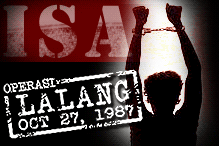 "Someone was shouting my name and knocking on the door. I opened it and saw a familiar face...he was a special branch officer from the Kajang police station," recalls Yap in the first interview he has given since
Operasi Lalang
, which marks its 18th anniversary today.
"Someone was shouting my name and knocking on the door. I opened it and saw a familiar face...he was a special branch officer from the Kajang police station," recalls Yap in the first interview he has given since
Operasi Lalang
, which marks its 18th anniversary today.
"The officer said: 'Sir, sorry, I am just following instructions. You are under arrest under the Internal Security Act (ISA). Please take some of your personal belongings and follow me to the police station'."
Yap and his wife reacted calmly. He made a few phone calls to MCA Youth colleagues from his Seri Kembangan home and accompanied the officer as ordered.
 He was one of 119 politicians,
social activists
, unionists,
Chinese educationists
and religious missionaries eventually rounded up under a massive police sweep code-named
Operasi Lalang
.
He was one of 119 politicians,
social activists
, unionists,
Chinese educationists
and religious missionaries eventually rounded up under a massive police sweep code-named
Operasi Lalang
.
Of them, 49 were detained without trial for two years or more, while others were released after several months at the Kamunting detention camp in Perak.
During that week of massive uncertainty and fear generated by the secret operations, the annual publishing permit of three newspapers - The Star , Sin Chew Jit Poh and Watan - was revoked as well.
Killing time
Yap says he was taken to the Sentul police station, then blindfolded and driven to another location, the identity of which he probably will never know.
When the blindfold was taken off, he saw four walls, a cement platform that would serve as a bed and what would have to pass for an 'attached bathroom'
His first challenge was not to succumb to "mental breakdown" especially during the initial days.
 "What could I do in a small cell? I could only talk to myself or give speeches in three languages. From time to time, when I spoke too loud, the warden would ask: '133 (his number), what are you doing, are you mad?'
"Freedom is very important for everyone, so you can imagine what it's like when you are (confined) in a room for that long."
Recollection is tempered with humour, a trait that many of those interviewed for this special malaysiakini series also revealed.
"I liked the interrogation period (of 60 days) very much," quips Yap. He was not treated badly, but lost 4kg in body weight.
He reckons that he was picked up because he had been vocal over the appointment of some 100 senior assistants and principals to Chinese primary schools, even though they were not fluent in Mandarin.
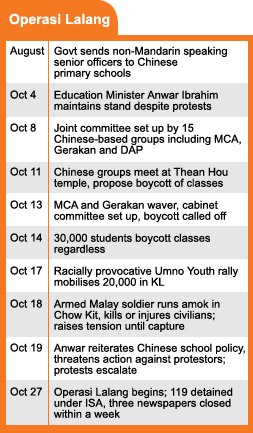 This episode had generated open criticism from Chinese-based groups and quarrels between political parties in the weeks leading up to
Operasi Lalang
.
(See chart)
This episode had generated open criticism from Chinese-based groups and quarrels between political parties in the weeks leading up to
Operasi Lalang
.
(See chart)
Yap does not regret his actions and insists that he should never have been detained as he was innocent, but acknowledges that this was done during a period of "political unrest".
"So, if I lost my freedom temporarily to help stabilise the (situation), then the detention was worth it. The mass arrests were meant to stabilise the entire political situation. This is why politicians from both the Barisan Nasional and opposition parties were detained."
They included (current) Deputy Home Minister Tan Chai Ho, Selangor state exco member Tang See Hang, Umno Pasir Salak division head Tajuddin Abdul Rahman and former Umno Pasir Mas MP Ibrahim Ali.
Sceptics, though, feel that the whole show was politically orchestrated - especially since politicians like Umno leader Najib Abdul Razak (now deputy president and deputy premier) and MCA's Lee Kim Sai were not arrested despite being as vehement over the Chinese school issue.
Of this, Yap says: "The cabinet asked him (Lee) to leave the country...it had no choice. If he was to be detained, Umno leaders Najib and Sanusi Junid would have had to be detained too. The unrest could have been worse."
Victims of circumstance
Yap's claim finds resonance in former MCA Youth vice-chairperson Chan Tse Yuen, another detainee, who recalls being told by an interrogating office that "we need a representative from each BN component party to be sent to Kamunting" at the end of the initial 60-day period in custody.
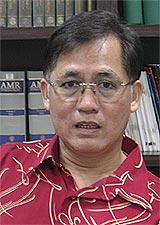 "He told me I was the candidate most recommended to represent MCA," says Chan, 53, who is now a lawyer.
"This made me sad. Those detained were not criminals, this was a political move. I'm very certain they were victims of circumstance...we have nothing to be ashamed of."
Although none of the BN leaders were sent to Kamunting as he had been told, Chan had sufficient exposure to detention conditions during even the relatively short period of interrogation.
He was arrested on Oct 30 after surrendering to the Petaling Jaya police. They had contacted him while he was chairing a MCA Youth meeting at the party headquarters in Kuala Lumpur.
"The police said my name was on the detention list, but that they knew I had a packed schedule and was out of town. This is why they did not detain me on Oct 27...they were understanding enough to wait for me to come back to KL."
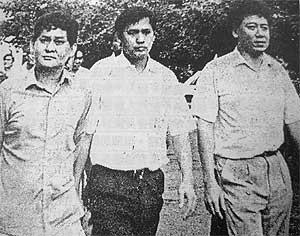 There was an 'upside' to his detention - it allowed him to catch up on sleep for "two, three days straight".
"I was treated extremely politely because the officials knew that Operasi Lalang involved political detainees. The biggest enemy inside was loneliness. Detention either breaks a person mentally or - if he or she gets past the first 60 days - it moulds someone who is stronger."
"I am not afraid of anything now. But I met an ex-detainee at a supermarket two months after I was released and he said he could not talk to me because he thought the special branch was watching and following us."
Confessions under duress
It has also emerged that there were double standards in treatment. Some of those from government even had their requests for Kentucky Fried Chicken and bak kut teh met during detention. Others had different experiences.
Today, if someone bangs on the door, pro-tem Parti Sosialis Malaysia president Dr Nasir Hashim is reminded of Operasi Lalang . He was detained for two years.
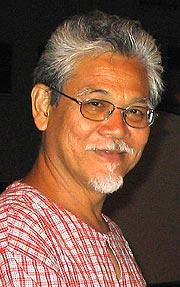 "I did not get any sleep during the first 60 days because the warden would come into my cell every few minutes, even when I had just fallen asleep. My hair started to fall out and I developed respiratory problems," says the medical practitioner.
"I believed I was held in an underground cell in (police headquarters) Bukit Aman. There was no sunlight, my shirts stank and my skin turned yellow."
Nasir, now 59, was then head of the Universiti Kebangsaan Malaysia community health studies department.
A political and social activist, he notes that there was no respect for the legal rights of detainees or for natural justice.
"Some were forced to confess to 'wrongdoing' during interrogation...the sessions were merely a platform to fish information to be used against the detainee," he says.
He remains appreciative of the support of his colleagues and of the fact that his children were not taunted by their friends after his arrest. But there was heartbreak, too.
"During the initial period of detention, my four-year-old daughter asked when I would be going home and I said 'soon'. When she next visited me, I was in Kamunting...she was really upset and said I had lied."
Three years after Nasir was freed, he and his wife divorced.
"This had something to do with the fact that I was detained for two years. We hardly met in that time and she was on her own in raising the children," he says with palpable sadness.
 Mahfuz Omar of PAS best remembers his two-year detention for the effect this had on his family - they supported him throughout, while his mother and brother dumped BN party Umno for opposition party PAS.
He was detained in Alor Setar, while returning home. At the time, he was the party's Penang Youth chief and MP for Pokok Sena.
"I told my wife not to visit me during the first 60 days because I expected to be ill-treated," he says.
Nasir and Mahfuz are firmly part of the current lobby that is demanding the repeal of the ISA.
 Yap feels there is a case for amendments but that the Act should be retained for use in cases where it is difficult to produce evidence in court, such as in the forging of passports or those believed to be involved in 'extremist' activities.
Not so Chan, who questions how anyone held unfairly or wrongly would ever be able to establish the truth, since there is no possibility of an open trial under the ISA.
"The opinion remains that racial tension could easily be incited. But it only means that, after 18 years, we - especially politicians - are still immature in handling social issues as Malaysians."


Are you sure you want to delete this comment?
This action cannot be undone.